Highly viscous and ultrafine copper tailings are difficult to dewater because fine particles can block the filtration surface, reduce vacuum stability and make filter cake discharge more difficult.
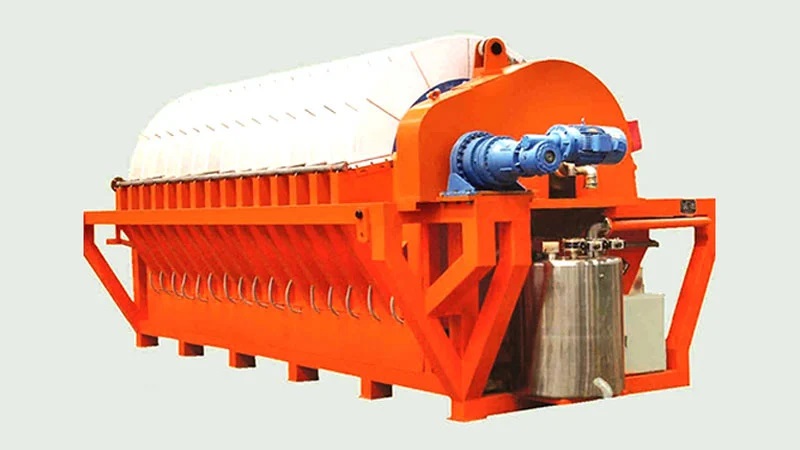
This video shows how Hesheng's CF vacuum ceramic disc filter is configured to address these challenges through gradient-pore ceramic plates, high-pressure pneumatic backwashing, online ultrasonic cleaning and corrosion-resistant vacuum components.
Filtration Challenges of Ultrafine Copper Tailings
Copper-tailings slurry with high viscosity and a large proportion of ultrafine particles can create several operating problems:
Rapid blockage of ceramic pores
Declining filtration capacity
Unstable vacuum conditions
Difficult filter cake discharge
Frequent cleaning and maintenance
Crystallization inside vacuum pipelines
Corrosion caused by sulfate and chloride ions
Conventional disc or drum filtration systems may struggle to maintain stable performance when these conditions occur simultaneously.
Hesheng's CF Ceramic Disc Filtration Solution
Gradient-Pore Ceramic Plates
The CF ceramic disc filter uses sintered white fused alumina ceramic plates with an optimized gradient pore-size surface.
The surface structure is designed to reduce the penetration of ultrafine particles into deeper ceramic pores while maintaining liquid permeability during filtration.
This helps reduce pore blockage and supports more stable filtration performance.
High-Pressure Pneumatic Backwashing
After cake discharge, high-pressure pneumatic backwashing removes retained particles from inside the ceramic pores.
The system helps limit the gradual decline in filtration rate that can occur during continuous operation.
Online Ultrasonic Deep Cleaning
An integrated ultrasonic cleaning system provides deeper ceramic-pore cleaning when normal backwashing is insufficient.
Online cleaning helps restore plate permeability and reduce the need for frequent manual cleaning or production shutdowns.
Anti-Crystallization Vacuum Piping
Copper-tailings slurry may contain sulfate and chloride ions that can contribute to crystal and deposit formation.
The CF system uses an anti-crystallization vacuum-pipeline design to reduce deposit accumulation and maintain more stable vacuum transmission.
Corrosion-Resistant Sealing Structure
Corrosion-resistant seals and slurry-contact components are used to improve equipment reliability under chemically aggressive tailings conditions.
The final material configuration should be selected according to slurry pH, ion concentration, temperature and operating conditions.
Operating Benefits
The combined filtration and cleaning design is intended to provide:
Reduced ceramic-pore blockage
More stable vacuum performance
Lower filtration-capacity decline
More reliable filter cake discharge
Reduced cleaning frequency
Improved continuous-operation stability
Better resistance to corrosive and crystallizing conditions
 EN
EN
 ko
ko  fr
fr  de
de  es
es  it
it  ru
ru  pt
pt  ar
ar  fa
fa  Hesheng Filter
 Call us on:
  Email Us:
  No.255 Shenzhen North Road, Laixi City, Qingdao City, Shandong P.R, China