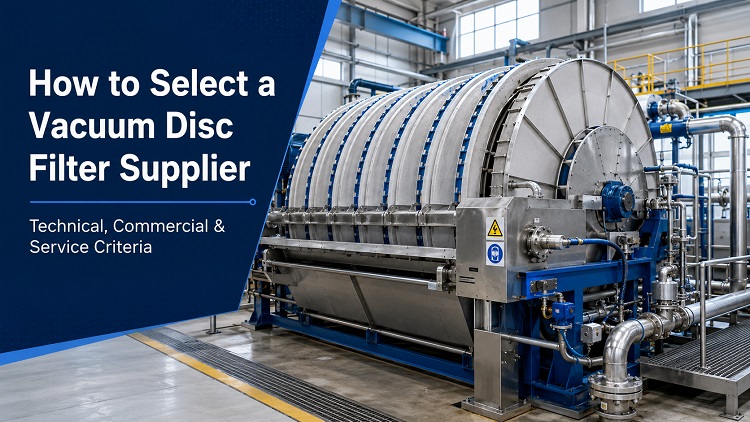
Selecting a vacuum disc filter supplier is not simply a matter of comparing equipment prices. The filtration system must match the slurry characteristics, required production capacity, target filter cake moisture, available utilities, operating environment, and long-term maintenance resources of the plant.
A poorly matched vacuum disc filter may still run, but it can suffer from low throughput, unstable cake formation, excessive moisture, blocked filter media, high cleaning frequency, or premature component wear. A qualified supplier should therefore do more than provide a quotation. The supplier should evaluate the filtration process, explain the basis of equipment selection, and support the system throughout installation and operation.
This guide explains how to compare vacuum disc filter suppliers, what technical information to request, which performance claims require verification, and how to reduce project risk before placing an order.
Confirm Which Type of Vacuum Disc Filter the Supplier Offers
The term "vacuum disc filter" can refer to different equipment designs. Before comparing suppliers, confirm the filtration medium and operating principle of the proposed machine.
A conventional rotary vacuum disc filter normally uses filter cloth mounted on metal disc sectors. A ceramic vacuum disc filter uses microporous ceramic plates as the filtration medium. Both operate continuously and use vacuum pressure, but their filtration behavior, cleaning methods, energy requirements, maintenance priorities, and suitable materials may differ.
A ceramic disc filter typically completes the following operating cycle:
The discs rotate into the slurry tank.
Vacuum and ceramic capillary action draw liquid through the plates.
Solids form a cake on the ceramic surface.
The cake continues to dewater outside the slurry.
Scrapers remove the cake in the discharge zone.
Backwashing and periodic cleaning restore plate permeability.
Hesheng's CF ceramic disc vacuum filter uses ceramic plates, a vacuum drainage system, a slurry agitation system, backwashing, and ultrasonic cleaning to support continuous solid-liquid separation.
A supplier should clearly explain whether the proposed equipment is:
A ceramic vacuum disc filter
A cloth-type rotary vacuum disc filter
A pressure-assisted disc filter
A disc thickener rather than a dewatering filter
These machines should not be treated as interchangeable simply because they all contain rotating discs.
Provide Complete Slurry Data Before Requesting a Quotation
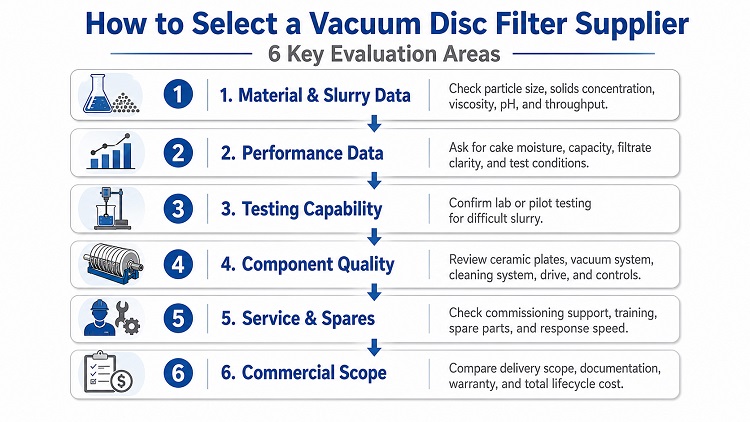
A reliable vacuum disc filter supplier should request material and process data before recommending a model. A quotation based only on hourly flow rate or desired machine size is unlikely to provide a dependable selection.
At minimum, provide:
Material or mineral type
Feed flow rate
Feed solids concentration
Particle-size distribution
Slurry density and viscosity
Temperature and pH
Abrasiveness and corrosiveness
Required dry-solids throughput
Target filter cake moisture
Required filtrate clarity
Daily operating hours
Available vacuum, water, air and electrical utilities
Particle-size distribution is particularly important. Two slurries with the same solids concentration can have very different filtration rates if one contains a higher proportion of ultrafine particles.
Viscosity also affects how quickly liquid can move through the cake and filter medium. Highly viscous slurry may require slower disc rotation, a different filtration area, improved agitation, or preliminary testing.
The supplier should use these inputs to determine:
Required filtration area
Number and diameter of discs
Disc rotation speed
Vacuum system capacity
Slurry tank and agitator configuration
Ceramic plate specification
Cake discharge arrangement
Cleaning system capacity
Materials of construction
A professional supplier should also identify missing data instead of making unsupported assumptions.
Ask for Performance Data Based on Comparable Materials
Performance data should be linked to a specific material and operating condition. Claims such as "high capacity," "low cake moisture," or "energy saving" are not sufficient without a technical basis.
For example, Hesheng's application reference table provides different performance ranges for different mineral concentrates:
Material | Feed Solids Concentration | Reference Cake Moisture | Reference Capacity |
Gold concentrate | 50–60% | 6.5–11.5% | 900–1,500 kg/m²·h |
Copper concentrate | 45–60% | 13–16% | 400–600 kg/m²·h |
Iron concentrate | 40–60% | 6–10% | 850–1,500 kg/m²·h |
Zinc concentrate | 50–60% | 6.2–12% | 750–900 kg/m²·h |
Lead concentrate | 50–65% | 10–12% | 650–800 kg/m²·h |
These figures show why a single universal capacity claim is unreliable. Copper concentrate in this reference table has a substantially different filtration rate and cake-moisture range from iron or gold concentrate.
The values should be treated as application references rather than guaranteed project results. Actual performance depends on mineralogy, particle distribution, viscosity, slurry chemistry, operating vacuum, disc speed, plate condition, and plant operation.
Evaluate the Supplier's Testing and Engineering Process
Material testing is one of the most valuable ways to reduce filtration project risk. It is especially important for ultrafine, highly viscous, variable, abrasive, or previously untested slurry.
A capable vacuum disc filter supplier should be able to explain the testing procedure and how the results will be converted into full-scale equipment selection.
Testing should also consider variation. A filter selected only around the plant’s best-quality feed may underperform when solids concentration, particle size, or mineral composition changes.
Ask whether the proposed filtration area includes a design margin. The supplier should explain why the margin is appropriate rather than automatically oversizing the machine. Excessive filtration area can increase purchase cost and footprint, while insufficient area can prevent the plant from reaching production targets.
Hesheng evaluates ceramic filtration projects according to slurry characteristics, capacity requirements, target cake moisture, and operating conditions before recommending equipment configuration.
Inspect the Ceramic Plates and Core Components
Ceramic plates are the core filtration medium in a ceramic vacuum disc filter. Their pore structure, mechanical strength, chemical resistance, and cleaning requirements directly affect filtration capacity, cake moisture, and operating stability.
The supplier should explain the ceramic sector specification, plate mounting method, recommended cleaning procedure, and replacement lead time. It is also important to confirm whether the plate material is suitable for the slurry's pH, temperature, abrasiveness, and chemical composition.
Other critical components include the distribution valve, main shaft, bearings, slurry agitator, vacuum and filtrate piping, scrapers, ultrasonic cleaning system, drive unit, and electrical controls. These items should be clearly listed in the quotation rather than grouped under a vague description such as “standard accessories.”
Hesheng's CF rotary vacuum disc filter system includes the slurry tank, ceramic plates, main shaft, agitation system, vacuum drainage system, plate regeneration system, and electrical controls. Cleaning combines routine backwashing with periodic ultrasonic or chemical cleaning when required.
Review Manufacturing Quality and Technical Documentation
Manufacturing accuracy can affect shaft alignment, disc rotation, sealing, vacuum stability, and long-term reliability. Before ordering, confirm how the supplier inspects the equipment during fabrication and factory testing.
The supplier should be able to provide relevant material certificates, alignment records, electrical component information, trial assembly results, and factory acceptance documents.
A complete technical documentation package should normally include the general arrangement drawing, foundation drawing, process flow, electrical schematic, utility requirements, operating manual, maintenance schedule, and recommended spare-parts list.
Confirm Installation and After-Sales Support
A vacuum disc filter cannot achieve stable performance through equipment quality alone. Correct installation, vacuum piping, instrument calibration, slurry preparation, commissioning, and operator training are also important.
Before placing an order, clarify whether the supplier provides foundation review, installation guidance, commissioning, performance testing, and operator training. The responsibilities of both the supplier and buyer should be written into the contract.
After-sales support should also cover troubleshooting, spare-parts supply, ceramic plate replacement, and operating-data review. Ask how quickly the supplier can respond if the machine experiences low vacuum, plate blockage, uneven cake formation, or reduced capacity.
Hesheng provides technical and after-sales service for equipment selection, installation guidance, commissioning, and filtration-system operation.
Common Warning Signs When Selecting a Supplier
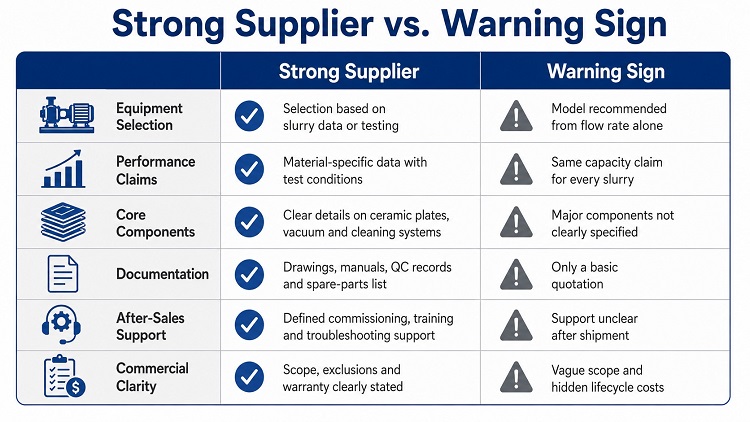
Several warning signs should be addressed before an order is placed.
A supplier may present higher project risk when it:
Guarantees cake moisture without reviewing slurry data
Refuses to explain filtration-area calculations
Uses identical performance claims for unrelated materials
Cannot provide details about ceramic plates
Does not include vacuum and cleaning-system requirements
Provides no comparable application references
Cannot identify slurry-contact materials
Offers no factory acceptance testing
Excludes commissioning without clearly stating it
Has no practical spare-parts plan
None of these points automatically disqualifies a supplier, but each requires clarification in writing.
A strong quotation should make the technical boundaries clear. It should state what is included, what is excluded, what data the selection is based on, and which performance conditions must be maintained by the buyer.
Frequently Asked Questions About Vacuum Disc Filter Suppliers
What information should a supplier request before recommending a model?
The supplier should request the slurry type, solids concentration, particle size, viscosity, throughput, target cake moisture, filtrate quality, operating hours, and available utilities. A reliable model selection cannot be based on flow rate alone.
Should I choose a ceramic or cloth-type vacuum disc filter?
A ceramic disc filter is often suitable for fine mineral slurry, continuous dewatering, and clear filtrate recovery. A cloth-type rotary disc filter may be more appropriate for other materials. The final choice should be based on testing and process requirements.
How is vacuum disc filter capacity determined?
Capacity is normally calculated from the dry-solids filtration rate per unit of effective filtration area. The supplier must also consider cake formation time, drying time, disc speed, slurry variation, and a suitable design margin.
Which spare parts should be ordered with the machine?
Common spare parts may include ceramic sectors, scrapers, seals, valve components, bearings, sensors, and ultrasonic-system parts. The supplier should recommend quantities based on equipment configuration and local parts availability.
Conclusion
The best vacuum disc filter supplier is not necessarily the company offering the lowest price or the largest machine. A dependable supplier should be able to explain why the proposed equipment matches the slurry and production requirements.
Before making a decision, confirm that the supplier:
Evaluates complete slurry and process data
Supports performance claims with comparable references or testing
Clearly defines the filtration area and auxiliary systems
Provides transparent component specifications
Includes appropriate documentation and quality records
Supports installation, commissioning, training, and spare parts
Hesheng evaluates slurry characteristics, required throughput, target cake moisture, filtration behavior, and plant conditions before recommending a vacuum disc filtration system.
For preliminary selection, provide the material name, feed solids concentration, particle-size distribution, required capacity, target cake moisture, pH, temperature, and daily operating time. This information helps determine whether a ceramic vacuum disc filter or another solid-liquid separation system is the more suitable choice.
 EN
EN
 ko
ko  fr
fr  de
de  es
es  it
it  ru
ru  pt
pt  ar
ar  fa
fa  Hesheng Filter
 Call us on:
  Email Us:
  No.255 Shenzhen North Road, Laixi City, Qingdao City, Shandong P.R, China